

Article: The Story of Tartan: How Christmas Borrowed a Scottish Classic

The Story of Tartan: How Christmas Borrowed a Scottish Classic

Every autumn, it happens.
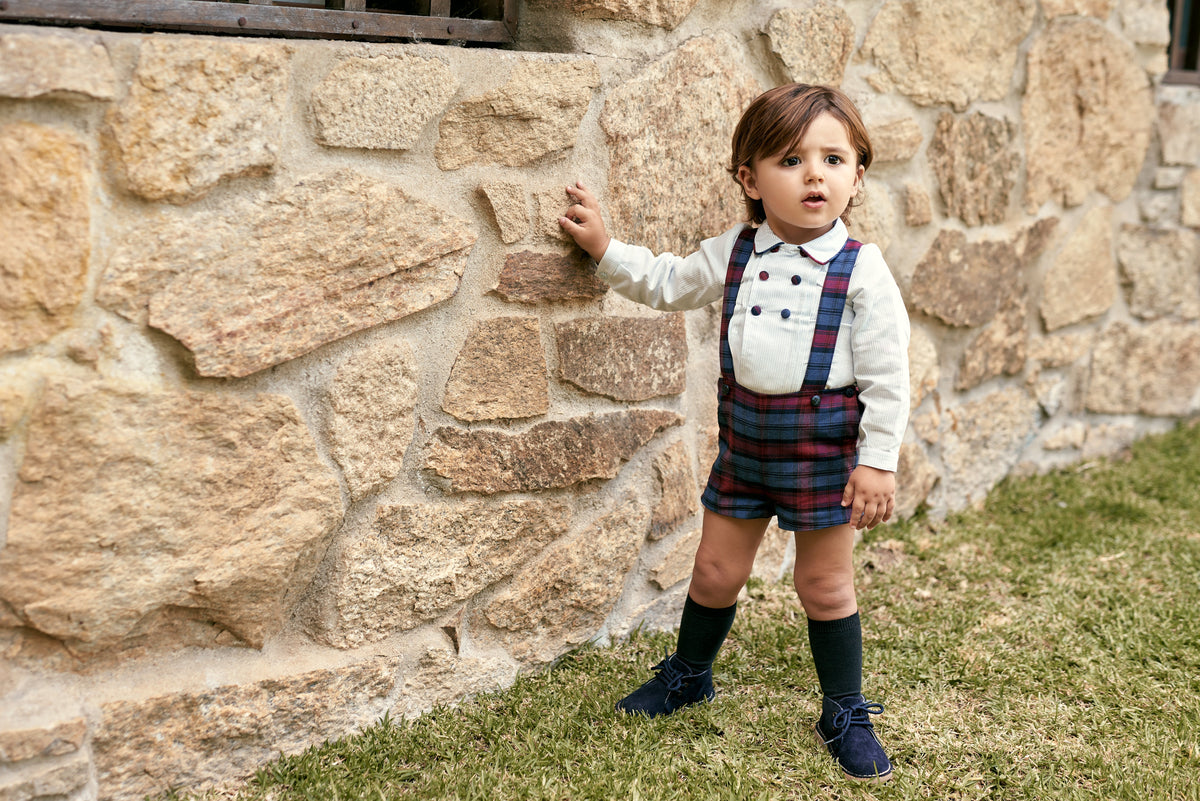
The temperatures begin to drop, holiday collections start arriving, and suddenly tartan seems to be everywhere: deep reds and forest greens, navy and burgundy, chocolate brown mixed with blue. It appears on dresses, little boys’ sets, coats, bows, pajamas, and matching sibling outfits.
And almost inevitably, we begin to think:
Christmas.
But here’s the interesting part.
Tartan was never created for Christmas. Christmas simply adopted it.
So how did a centuries-old Scottish textile become one of the patterns we associate most strongly with the holiday season? And perhaps more importantly for anyone standing in front of their child’s closet in January: is tartan really only for Christmas?
The answer is no.
And the story behind it is much more interesting.
First Things First: What Is Tartan?
Tartan is more than simply a check.
It is a pattern created by colored bands crossing horizontally and vertically in a repeating sequence. That particular arrangement of lines and colors is known as the tartan’s sett.
Today, we often use the words tartan, plaid, and check interchangeably, particularly in the United States, but they aren’t quite the same thing.
Gingham is a check. Windowpane is a check. Tattersall, houndstooth, and Prince of Wales check all belong to the larger world of checked fabrics.
Tartan has its own construction and, more importantly, an extraordinary cultural history.
And while tartan is unmistakably connected with Scotland, another common assumption deserves correcting:
Not every tartan represents a Scottish clan.
Historically and today, tartans can be associated with clans and families, geographical districts, military regiments, royalty, organizations, commemorative events, and even fashion.
Yes... fashion tartans are very much a thing.
Which brings us to the tartans we see season after season in European childrenswear.
From Heritage to Fashion
Tartan existed long before it became an international fashion statement.
Its transformation accelerated dramatically during the 19th century, when fascination with Scottish culture spread throughout Britain and beyond. Tartan moved outside its traditional context and into fashionable wardrobes, interiors, accessories, and eventually mass-market textiles.
Queen Victoria and Prince Albert also played an important role in the Victorian fascination with Scotland. Their love of Scotland and Balmoral helped make Scottish aesthetics enormously fashionable during the period.
At the same time, textile manufacturing was changing.
Industrial production and new dyes allowed manufacturers to create tartans in increasingly varied colors and quantities. Tartan was no longer confined to its earlier uses.
It had become fashion.
And something else was happening during precisely this period.
Christmas was changing, too.
Enter the Victorians... and Christmas as We Know It
Many of the traditions we now consider inseparable from Christmas became enormously popular during the Victorian era.
The Christmas tree. Christmas cards. Crackers. Elaborate decorations. Gift giving. And perhaps most importantly, the idea of Christmas as a celebration centered around children, family, home, and tradition.
Queen Victoria, Prince Albert, and their children helped popularize this image of the family Christmas. Images of the royal family gathered around a decorated Christmas tree were widely circulated and enormously influential.
Now consider what was happening culturally at the same time.
- Tartan was fashionable.
- Scottish heritage was romanticized.
- Christmas was becoming an increasingly visual, family-centered celebration.
Both communicated ideas of tradition, heritage, warmth, family, and home. The two worlds fit together remarkably well.
It would be too simple to say that the Victorians turned tartan into a Christmas fabric overnight. They didn’t.
Instead, tartan and the modern Christmas grew within the same cultural moment—and over time, their visual languages began to overlap.
Then Commerce Did the Rest
This is where the story becomes particularly interesting.
Because Christmas didn't just become a major cultural celebration.
It became a major commercial season.
As department stores, catalogs, advertising, gift wrapping, holiday decorations, and eventually modern retail developed, Christmas acquired its own increasingly recognizable visual identity.
Certain colors became shorthand for the season.
Red.
Forest green.
Gold.
Deep navy.
And those colors happen to work extraordinarily well in tartan.

A red-and-green tartan could instantly communicate tradition, nostalgia, warmth, and Christmas without containing a single Christmas tree, snowflake, Santa Claus, or reindeer.
Retailers and designers understood its power.
And generation after generation of Christmas dresses, ribbons, tablecloths, wrapping paper, pajamas, and holiday advertisements reinforced the association.
Eventually, we stopped simply seeing a red-and-green tartan.
We saw Christmas.
But Here's the Important Part: Not Every Tartan Is Christmas Tartan
This is where things get fun.
Take the exact same structure of intersecting lines and change the colors.
Suddenly, the message changes completely.
Red + forest green: unmistakably traditional Christmas.
Burgundy + bottle green: festive, but sophisticated enough for the entire winter.
Chocolate + dusty blue: autumn and winter.
Camel + navy: classic heritage.
Navy + green: traditional and preppy.
Blue + cream: soft winter dressing.
Pink + grey: fashion.

The tartan hasn't fundamentally changed.
Our cultural interpretation of the colors has.
And that distinction is particularly important when we're talking about children's clothing.
So, Is Tartan Only for Christmas?
Absolutely not.
In fact, we would argue that most tartan belongs much more naturally to the broader Autumn/Winter wardrobe than specifically to Christmas.
A traditional red-and-green tartan will always carry a particularly strong holiday association. If you love that quintessential Christmas look, embrace it. There is something wonderfully nostalgic about children dressed in traditional tartan for Christmas.
But brown, blue, camel, burgundy, navy, cream, and softer green tartans?
Those can move beautifully through the entire season.
September and October with loafers or simple canvas shoes.
November for Thanksgiving and family photographs.
December dressed up for Christmas.
January and February layered with knitwear, tights, coats, and boots.
The secret isn't asking:
“Is this tartan?”
The better question is:
“Which tartan is it?”
Why Tartan Works So Beautifully for Children's Clothing
Perhaps this is also why we continue to see tartan return in European childrenswear year after year.

Children's fashion has a special relationship with tradition.
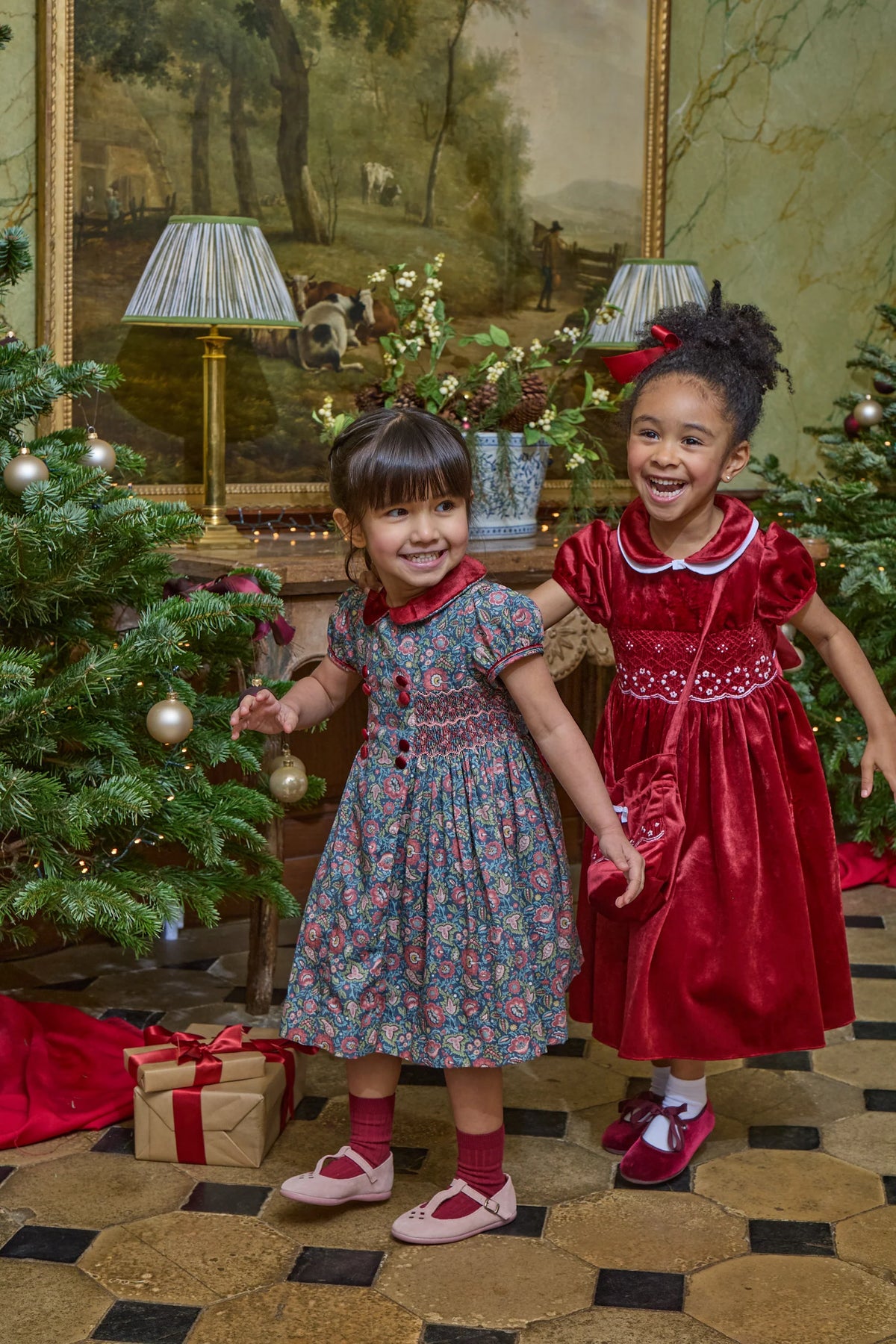
Peter Pan collars. Smocking. Knits. Mary Janes. Bloomers. Beautifully tailored little coats. Matching siblings.
These are details that can feel nostalgic without feeling like costumes. We recognize something from childhood in them, even as designers reinterpret them for children today.
Tartan works in much the same way.
It carries history without requiring us to dress exactly as previous generations did.
A designer can take a traditional textile language and change the proportions, colors, silhouettes, or styling.
Suddenly something centuries old feels completely current.
And perhaps that is tartan's greatest strength.
It evolves without losing its identity.
Christmas Borrowed Tartan... But Winter Gets to Keep It
So the next time you see tartan arriving with the Christmas collections, remember:
It wasn't born as a Christmas print.
Tartan traveled from heritage to fashion, through centuries of changing tastes and traditions, until certain versions of it became inseparable from the visual language of the holidays.
Christmas may have claimed the red and green version particularly enthusiastically.
But tartan itself belongs to a much bigger story.
And that is exactly why we love seeing designers experiment with it each Autumn/Winter season—from the most traditional holiday reds to unexpected combinations of chocolate, blue, camel, burgundy, and cream.
Some tartans are unmistakably Christmas.
Others simply whisper winter.
And the very best ones?
They can do both.
Where European tradition meets modern childhood.
El Rincón de María

Written by Ana Maria Certain
Leave a comment
This site is protected by hCaptcha and the hCaptcha Privacy Policy and Terms of Service apply.